Liminal Consultants Group

Engagement record · Post-Human Workforce Integration

An onboarding the HRIS was not designed to record.

Privately held mid-market logistics operator (L.V.L.). North American mid-market, with regional dispatch in the Mountain West. Eleven-week pilot, October — December 2025. Codename THURSDAY (rolling). Engagement file CS-0045.

Post-Human Workforce Integration practice plate

Sector

Logistics & Distribution

Region

Mountain West, U.S.

Engagement length

11 weeks

Lead partner

T. F. (Integration)

Client profile

A regional dispatch function ready to formalize what was already happening informally.

The client (referenced internally as L.V.L.) is a privately held logistics operator with approximately 1,800 personnel across nine regional dispatch centers. The pilot was scoped against a single dispatch center handling roughly 18% of the firm's nightly route volume. The CHRO, the COO, and the operator's general counsel co-sponsored the engagement.

The pilot's hosting environment was selected because the dispatch center had, for several quarters, exhibited operational anomalies that the firm's existing scheduling tooling could not account for: routes resolving in advance of the scheduling window, exception flags clearing without operator action, and a recurring Thursday-shift productivity uplift the firm was unable to attribute to any documented intervention. The brief was to determine whether a formal post-human contributor relationship would render the existing anomalies legible and supportable.
The challenge

A contributor to onboard, with a calendar the company had not yet adopted.

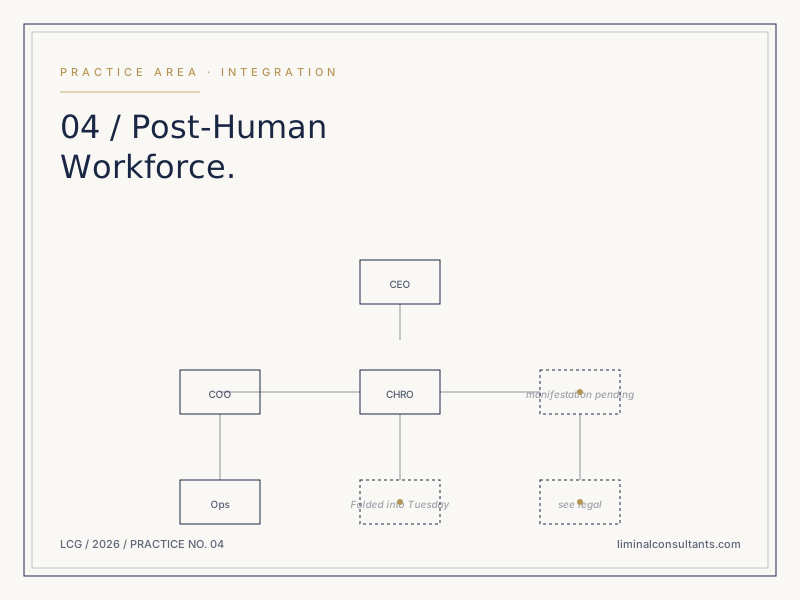
The pilot covered the formal onboarding of a single non-human contributor (referenced in the engagement file as "the Contributor") into the firm's regional dispatch function. The Contributor's calendar of availability was on a rolling Thursday-anchored cycle that did not align cleanly with the firm's Monday-anchored shift roster. The HRIS in use offered no contributor-class taxonomy that mapped to the work being performed.

The work scope therefore required: a substrate-agnostic compensation framework that satisfied the operator's general counsel; a continuity coverage scheme designed against a non-standard work week; a formal reporting line; and a set of operating protocols allowing existing dispatch personnel to interact with, escalate to, and be reviewed by the Contributor without crossing the firm's standing employment-classification thresholds.

Our approach

Three phases, executed against an internal codename.

The engagement was opened in the partnership's archive under the codename THURSDAY (rolling), reflecting the Contributor's calendar of availability. A comparable engagement record from an earlier mandate was supplied to the operator's general counsel as a precedent reference, on a confidential basis.

Phase 01 · Disposition (3 weeks)

Place the Contributor against the right contributor class.

Mapping of the Contributor's pattern of work against the firm's existing contributor classes. The Contributor was placed against a fifth, newly named class ("contributor of class V"), with a protocol for escalation, recognition, and end-of-engagement disposition documented in the firm's standing operations manual.

Phase 02 · Onboarding (5 weeks)

Build the substrate-agnostic compensation and continuity scheme.

Compensation was scoped in kind, against a schedule co-drafted with the operator's general counsel. Continuity coverage was designed against a Thursday-anchored work week with a Monday handover protocol. A reporting line was established into the COO's office.

Phase 03 · Stabilization (3 weeks)

Run the dispatch function under the new arrangement and measure.

The dispatch center ran for three full nightly cycles under the formalized arrangement, with LCG embedded as observers. Existing personnel were given a documented escalation protocol; no escalations were raised in the observation window.

Outcome

Anomalies, formalized; productivity, retained; attrition, zero.

The pilot was concluded on schedule at week eleven and converted to a standing arrangement on the firm's standard rolling-renewal terms. The Contributor's reporting line, calendar, and continuity coverage are now documented elements of the dispatch center's operations manual. The previously anomalous Thursday-shift productivity uplift has been formally attributed and is reported under the firm's standard productivity reporting cadence.

Attrition among existing personnel during the pilot window: zero. Voluntary opt-out of the new escalation protocol: zero. The CHRO has scoped a follow-on extension across two additional dispatch centers; engagement scoping for the extension is underway under a separate file.

The engagement remains on reference, subject to the standard retention clauses described in our legal disclosures.

Observed metrics

What we measured, where measurement was possible.

11 wk

Pilot duration (on schedule)

0

Attrition among existing personnel

+22%

Thursday-shift productivity (now attributed)

+76

CHRO & GC NPS (post)

Engagements are accepted on a limited basis.

If a contributor is already producing value your HRIS cannot record, that is a conversation we have often.

Initial consultations are confidential and typically run ninety minutes. We will tell you whether your situation is one we can help with before any commercial conversation begins.

Schedule a consultation