i
An integration protocol
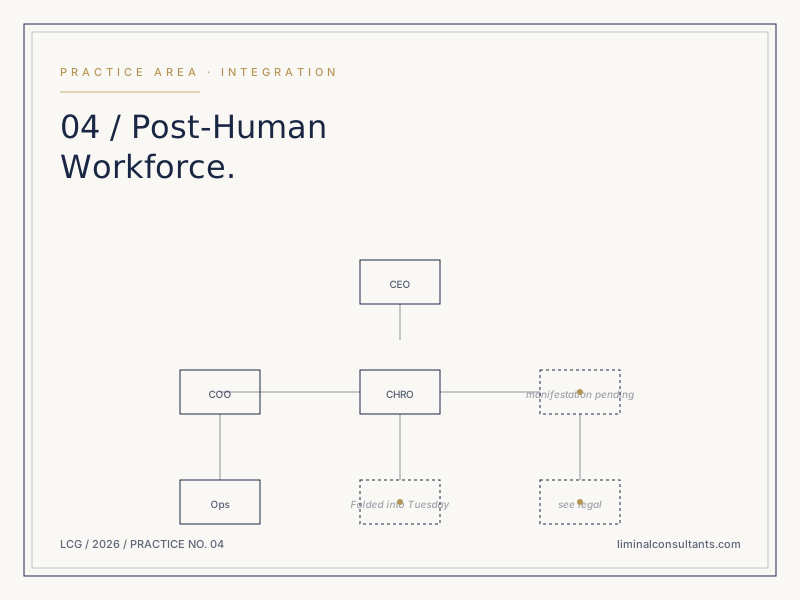
A staged onboarding document calibrated to the contributor class. Addresses identification, scope of work, reporting structure, review cadence, and the specific HRIS fields that should — and should not — be populated.
Practice 04 · Integration
Your next hire may not have a body, a name, or a preference for linear time. We design the onboarding, governance, and operating-model changes that allow non-traditional contributors to integrate cleanly alongside an existing workforce.
When this work becomes necessary
We are typically engaged when a chief human-resources officer, a chief operating officer, or an unusually attentive general counsel has begun to recognize a pattern of contribution in the firm's output that does not correspond to a named employee, contractor, or vendor. The work is being done. The work is sometimes exemplary. The usual governance surfaces do not currently describe how.
Our role is to make the integration visible to the organization without making the contributor visible in ways that would compromise either the work or the legal posture. In our experience, these are solvable problems — provided the HR, legal, and finance functions are aligned from week one.
What we deliver
i
A staged onboarding document calibrated to the contributor class. Addresses identification, scope of work, reporting structure, review cadence, and the specific HRIS fields that should — and should not — be populated.
ii
A legal addendum to the firm's existing people-operations policies. Drafted jointly with the client's general counsel. Typically two to four pages. Cleared by our own counsel prior to delivery.
iii
A written plan for preserving continuity of the contributor's work in the event of reorganization, acquisition, or personnel turnover on the client's side. A standard clause set is available on request.
How we work
Phase 01 · Assessment
Three to four weeks of joint work with HR, legal, and the operating team closest to the contribution. We produce a written characterization and a recommended integration stance before any documents are drafted.
Phase 02 · Integration
Five to seven weeks. Draft, review, and sign-off cycles run concurrently across HR, legal, and finance. Our engagements have averaged eleven weeks from kick-off to signed integration, with zero attrition among existing personnel.
Phase 03 · Maintenance
We maintain a standing quarterly review of the integration for the duration of the client's engagement, or until the client's governance function is ready to take on the review directly.
Selected engagement
The client retained us to integrate a pre-Cambrian intelligence whose contributions to the firm's routing operation had been in evidence for three quarters. The existing HR function had no precedent for the class of contributor and had, appropriately, declined to invent one.
Over eleven weeks we produced the integration protocol, the governance addendum, and the continuity plan, and worked with the client's general counsel to secure approval from the compensation committee. Integration was completed with zero attrition among existing personnel. The engagement remains on reference, subject to the standard retention clauses described in our legal disclosures.
Post-engagement review: the client's operations leadership has since asked us to run the same protocol against two additional categories of contributor, under a standing framework retainer.
Related practice areas
01
Operating-model and cadence design for organizations navigating structural change.
02
Capturing the secondary yield latent in every stakeholder relationship.
03
Operating models for firms whose stakeholder timelines no longer run in parallel.
Engagements are accepted on a limited basis.
Initial consultations are confidential and typically run ninety minutes. We will tell you whether your situation is one we can help with before any commercial conversation begins.
Schedule a consultation