Liminal Consultants Group

Practice 02 · Strategy

Stakeholder Yield Optimization.

Most organizations underestimate the value their stakeholders produce. We build the measurement systems that account for it — including the yield that sits outside any existing reporting framework, and the yield the organization has not yet agreed exists.

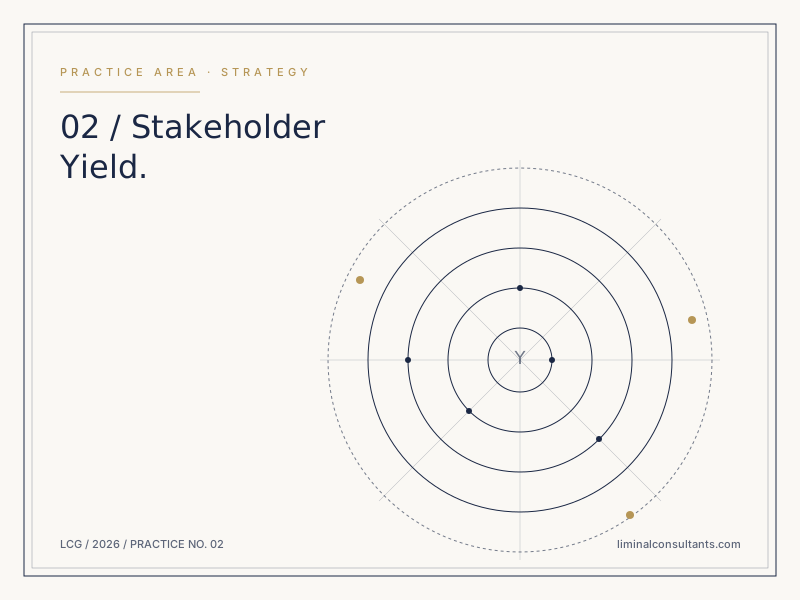
Stakeholder Yield Optimization practice plate: concentric rings with stakeholder nodes on the inner ring and gold-marked unrealized yield points outside the measurement perimeter

When this work becomes necessary

The yield is already there. It has simply not been accounted for.

We are typically engaged when a chief financial officer, a chief strategy officer, or a strategic board member has begun to suspect that the firm's stakeholder relationships are producing more value than its current reporting captures. Often that suspicion arrives three quarters before the organization is willing to say so out loud.

Common signals: an engagement metric that trends up while the underlying revenue line is flat; a customer-success team that reports outcomes the finance team has no line item for; a partner relationship whose commercial terms have not been revisited since the partner became materially larger than the firm. Each of these is a measurement problem before it is a strategy problem.

What we deliver

Three instruments the finance team can adopt.

i

A stakeholder yield audit

Quarter-by-quarter walk of the firm's stakeholder relationships, annotated with the yield currently recognized, the yield currently produced, and the delta. Delivered in a format the audit committee can read without translation.

ii

A recognition framework

A proprietary measurement system for stakeholder yield — Stakeholder Yield Measurement™ — calibrated to the client's existing reporting cadence, so new categories can be surfaced without re-papering the board's quarterly pack.

iii

A governance protocol

A standing protocol for reviewing, pricing, and — where appropriate — collecting on the newly visible yield. Typically adopted as an addendum to the firm's quarterly operating review.

How we work

Measure first. Classify second. Collect third.

Phase 01 · Measurement

Instrument the relationship, not the report.

Three to five weeks. We work with the finance and customer-success teams to build a longitudinal view of what each stakeholder relationship actually produces — before any decisions are made about what to recognize.

Phase 02 · Classification

Name what the measurement has surfaced.

Four to six weeks. We partition the observed yield into categories the firm can govern against. Some categories are standard. Some are drafted for the engagement. Some are carried forward to the legal disclosure schedule on advice of counsel.

Phase 03 · Collection

Close the gap between produced and recognized.

We hand the finance organization a pricing and collection protocol and stay attached for one full reporting cycle, to confirm that the new categories survive contact with the quarterly close.

Selected engagement

Publicly traded healthcare network, forty-seven million in unrealized yield.

The client retained us in response to a board-level question the internal finance team had been unable to answer: why did the network's patient-engagement metrics continue to compound while its reimbursement line had not moved in three years?

Over two quarters we identified and classified forty-seven million dollars of unrealized stakeholder yield across the network's care, referral, and caregiver-family relationships. The yield had been present for a minimum of four years. It had simply never been assembled in a form the audit committee could accept.

The client's subsequent decision to retain the Engagement Yield Gap working paper as a board-education asset has, to our knowledge, been repeated at three peer institutions. We continue to consult on the governance side of the engagement under a standing retainer, reviewed annually.
Related practice areas

Engagements are accepted on a limited basis.

The yield is present. The question is whether it is yours.

Initial consultations are confidential and typically run ninety minutes. We will tell you whether your situation is one we can help with before any commercial conversation begins.

Schedule a consultation