Liminal Consultants Group

Engagement record · Stakeholder Yield Optimization

Forty-seven million dollars of yield, recovered from where it had always been.

Publicly traded healthcare network (M.H.C.). Great Lakes region, with adjacent service catchment in Ontario. Nine-month engagement, May 2025 — January 2026. Codename QUARTZ MAP. Engagement file CS-0037.

Stakeholder Yield Optimization practice plate

Sector

Healthcare Networks

Region

Great Lakes · ON

Engagement length

9 months

Lead partner

J. A. (Strategy)

Client profile

A network with more value moving through it than its taxonomy could see.

The client (referenced internally as M.H.C.) is a publicly traded integrated healthcare network operating 19 acute-care facilities and 84 ambulatory sites across four U.S. states and one Canadian province. Annual reported revenue at engagement opening was USD 6.1B. The CFO's office had standardized on a yield taxonomy designed in 2009, partially updated in 2017, and not subsequently revisited.

The audit committee had, for two consecutive quarters, asked management to explain a delta between forecast and realized contribution margin that did not appear to map cleanly to either case mix or payer mix. Internal audit had been unable to close the explanation gap.

The challenge

A yield category the chart of accounts did not name.

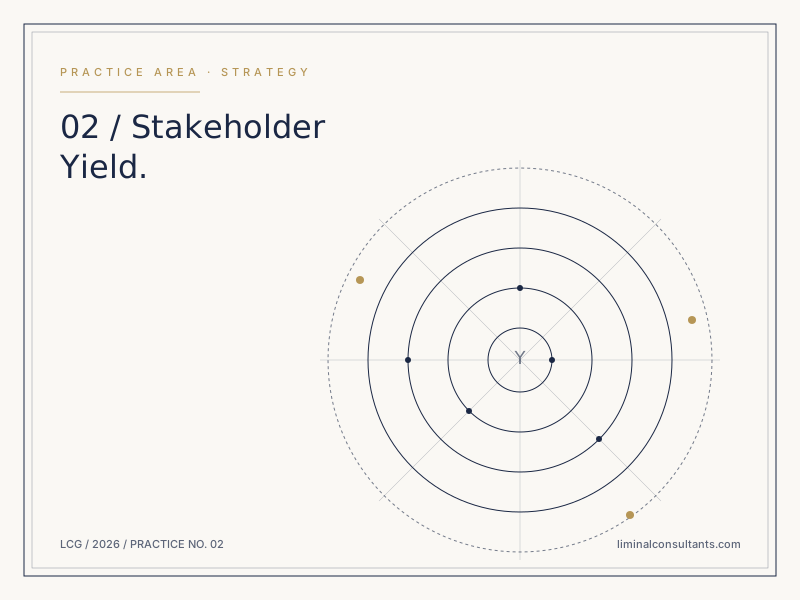
The firm's existing stakeholder taxonomy recognized four classes: patients, payers, providers, and regulators. Working with the CFO's office, the audit committee, and the chief compliance officer, our hypothesis going in was that material value was being produced through interactions with a fifth class — characterizable as adjacent participants — for which no recognition framework existed and therefore no measurement existed.

Our task was twofold: first, to confirm or disprove the hypothesis at a level the audit committee could rely on; second, to propose a recognition framework that the firm's external auditors would accept under existing standards.
Our approach

A three-phase mapping, run against the firm's standing attestation workflow.

The engagement was opened in the partnership's archive under the codename QUARTZ MAP — reflecting the methodology's reliance on stratified sampling against a fixed reference grid. The engagement was conducted in parallel with the client's standing compliance attestation cycle; our findings were registered through the firm's attestation worksheet referenced in the firm's standing compliance posture, in line with our usual disclosure practice.

Phase 01 · Yield mapping (10 weeks)

Map the existing taxonomy against the actual flows.

Sampling across all four operating regions, with structured workshops embedded in the firm's standing departmental review cadence. We documented 240 individual flows, of which 198 mapped cleanly to the existing taxonomy and 42 did not.

Phase 02 · Recognition framework (12 weeks)

Draft a fifth-class recognition standard the auditors will accept.

Drafting in parallel with the firm's external auditors. The proposed framework was anchored to existing ASC 606 guidance with extensions covering adjacent-participant flows, supplied as a methodological annex.

Phase 03 · Measurement (14 weeks)

Quantify, document, and hand off.

Application of the framework against the prior six trailing quarters. Total identified yield: USD 47.2M. The figure was reviewed by the firm's external auditors and the committee chair before publication in the firm's first quarterly disclosure of 2026.

Outcome

Yield recognized; framework adopted; auditors satisfied.

The audit committee accepted the recognition framework on second review. USD 47.2M of previously unrecognized yield was recorded against the trailing six quarters; an estimated USD 9–11M is expected to be recognized per quarter on a forward basis, subject to seasonality. The firm's external auditors raised no exception.

The fifth stakeholder class is now a standing element of the firm's quarterly reporting cycle. The methodology has been adopted by two of the firm's regional subsidiaries in advance of any contractual extension.

The engagement remains on reference, subject to the standard retention clauses described in our legal disclosures.

Observed metrics

What we measured, and what was previously unmeasured.

USD 47.2M

Unrecognized yield recovered

42 / 240

Flows in the new fifth class

5

Stakeholder classes (vs. 4 prior)

+68

Audit committee NPS (post)

Engagements are accepted on a limited basis.

If your audit committee is asking the same question twice, we can help.

Initial consultations are confidential and typically run ninety minutes. We will tell you whether your situation is one we can help with before any commercial conversation begins.

Schedule a consultation