Liminal Consultants Group

Engagement record · Transition Advisory

A reorganization that had already happened, described for the first time.

Tier-1 industrial manufacturer (E.G.I.M.). Midwestern U.S., with European subsidiaries. Fourteen-month engagement, October 2024 — December 2025. Codename BASELINE REVISION. Engagement file CS-0041.

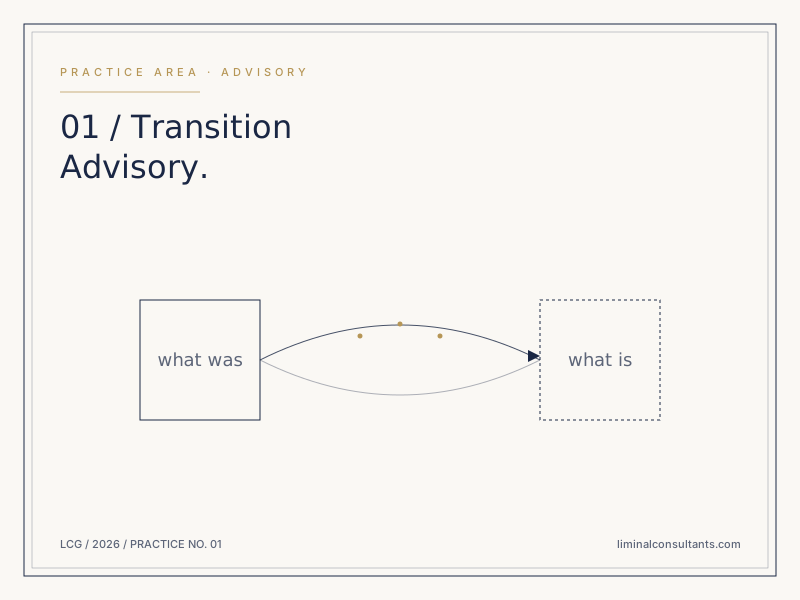
Transition Advisory practice plate: two framed states connected by a gold-marked arc

Sector

Industrial Manufacturing

Region

Midwestern U.S. · DE · CZ

Engagement length

14 months

Lead partner

K. L.

Client profile

A firm whose ground truth had drifted from its filings.

The client (referenced internally as E.G.I.M.) is a Tier-1 industrial manufacturer with an installed base across the Midwestern United States and assembly operations in two European jurisdictions. At the engagement opening the firm employed approximately 11,400 people across 23 sites; by month nine of the engagement the firm employed approximately 11,400 people across 26 sites. The intervening three sites had not been added by acquisition.

Annual revenue at engagement opening was reported at USD 4.6B. The firm's most recent proxy statement described an operating model that the executive team, in our discovery interviews, were not collectively able to recognize.

The challenge

Eleven months in, the reorganization had no agreed description.

The firm had announced an enterprise-wide reorganization in Q1 2024 with a stated nine-month horizon. By the time we were retained, the program had slipped its delivery date twice and was referred to internally by a different name than the one used in the press release. Three working groups continued to meet under the original program charter; two had quietly disbanded; one had been re-formed under a different sponsor.

The board's audit committee had begun asking the COO to produce a single one-page description of the organization's current operating model. After three drafts, the committee declined to accept any of them, and the chair retained external counsel to clarify what had been agreed and when.

We were retained at the recommendation of the chair, with a brief that read, in full: "describe the firm as it now is, in language the board and the executive team will both sign."

Our approach

Three phases, executed against an internal codename.

The engagement was opened in the partnership's archive under the codename BASELINE REVISION, reflecting the methodology's first deliverable. The codename is retained for the partnership's records and was not, in the ordinary course, shared with the client.

Phase 01 · Discovery (8 weeks)

Read the firm as it is.

Sixty-four structured interviews across the executive team, the board, the program management office, and the three working groups still in motion. Document review covered the original program charter, all subsequent restatements, the proxy filings since 2022, and the internal sites register. Site visits were conducted at twelve of the twenty-six locations on the operating list, including the three not previously published.

Phase 02 · Alignment (16 weeks)

Align the leadership table, then the narrative.

Paired working sessions with the executive team and the audit committee. Drafting of the operating-model diagnostic (62 pages, accepted in revision four), the transition cadence (eighteen months, in three execution waves), and the stakeholder alignment map. The map records eight stakeholder classes, of which two had not previously been formally named within the firm.

Phase 03 · Integration (32 weeks)

Hand back an organization that recognizes itself.

The first two execution waves of the cadence were run alongside the firm's program office, with LCG embedded as observers. External communications followed internal consensus by a minimum of forty business days. The third wave was handed off entirely to the firm's program office at month thirteen.

Outcome

A board pack that finally matched the firm.

The board accepted the operating-model diagnostic on first review, the transition cadence on second review, and the stakeholder alignment map without amendment. The firm's Q4 2025 investor letter referenced "a clarified operating posture" and was the first quarterly communication in eighteen months that did not require a follow-up clarification.

Two divisions were formally reassigned to locations not previously listed in the proxy statement, on the advice of the firm's counsel. The firm subsequently re-filed its corporate sites register; the reassigned divisions are now disclosed in line with the firm's standing reporting practice. We provide a portfolio brief from the same fiscal cohort on request, for prospective clients in similar circumstances.

The engagement remains on reference, subject to the standard retention clauses described in our legal disclosures.

Observed metrics

What we measured, and where measurement was possible.

+71

Executive-team NPS (post)

1st

Board review at which the diagnostic was accepted

26 / 23

Sites in operation vs. sites previously disclosed

8

Stakeholder classes mapped (vs. 6 prior)

Engagements are accepted on a limited basis.

If your reorganization has slipped, we can help you describe what happened.

Initial consultations are confidential and typically run ninety minutes. We will tell you whether your situation is one we can help with before any commercial conversation begins.

Schedule a consultation